
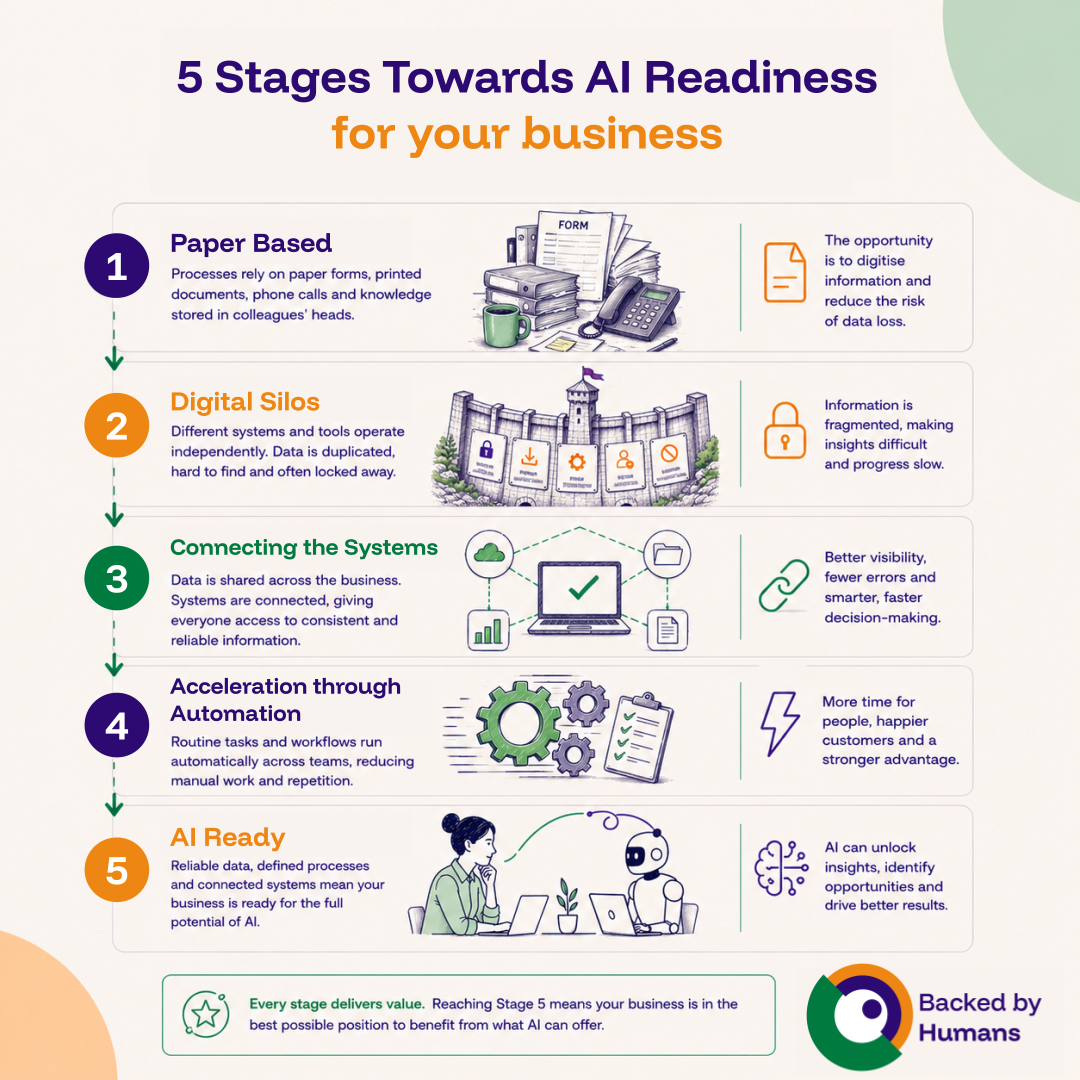
Reaching Stage 5 simply means your business is in the best possible position to benefit from what AI can offer.
So what will AI actually deliver for your business?
The answer depends less on the AI itself and more on the digital foundations that are in place.
At Backed by Humans, we think about this as a journey through 5 stages of digital maturity. Every stage delivers value in its own right by making the business easier to run, improving consistency and reducing administration. Reaching Stage 5 simply means your business is in the best possible position to benefit from what AI can offer.
Stage 1: Paper Based
At this stage, processes rely heavily on paper forms, printed documents, phone calls and knowledge stored in colleagues’ heads. The information that is remembered (or pencilled down) may be accurate, but it is difficult to share quickly across the team and often is highly dependent on an individual knowing how things work. This can impede a business’ growth and mean the business stops if key people are unavailable.
The opportunity at this stage is not AI. It is to begin digitising information, making information easier to find and share while reducing the risk of data loss.
Stage 2: Digital Silos
We expect many small to medium-sized businesses (SMEs) to recognise themselves at this stage. Paper has now largely disappeared and digital software is now part of everyday work. Spreadsheets, email, cloud storage, accounting software and specialist applications all play an important role and have brought benefits.
The challenge now is that these systems often operate independently of one another. Customer information is entered multiple times in various locations, documents exist in different folders and staff spend valuable time searching for information or copying data between systems. Another disadvantage is that your business’ data is often locked behind APIs that are only accessible through paid upgrades, or sometimes not accessible at all.
It is often at this point that businesses start looking towards AI. However, when information is fragmented across disconnected systems, any insights or recommendations are limited by the quality and completeness of the data available.
Stage 2 is a business that is becoming digital, but its information is still not efficiently connected.
Stage 3: Connecting the Systems
The next stage addresses this by aiming to connect information together.
Rather than each system holding its own version of the truth, data is shared across the business. Customer records, project files, documents and operational information are connected, giving everyone access to consistent and reliable information.
Now, businesses often notice significant improvements. Colleagues spend less time checking information, data mistakes become less frequent and leadership has greater visibility of what is truly happening across the business.
With these connected data sources, reporting becomes easier and faster, supporting decision making with data that considers the whole picture.
Stage 4: Acceleration through Automation
Once data is flowing across your organisation, automation is the next opportunity.
Routine tasks such as notifications, standard approvals and information sharing can happen automatically across teams. Staff are no longer copying and pasting information between tools or spending hours repeating similar administrative tasks.
Whilst time savings are an obvious benefit, this is often the stage where SMEs begin to gain a real competitive advantage. As administrative tasks reduce, teams have more time to solve complex problems and support their customers more, generating greater satisfaction and brand loyalty.
Stage 5: Ready for AI
The saying “rubbish in, rubbish out” (or the more expletive version…) rings true here.
Thankfully, at this stage, the data is now reliable and trustworthy. Processes are well defined and automated. Systems are connected. There is confidence in the quality of the information being used across the business by everyone.
Now your business is ready for the full potential of AI.
AI can now be used to analyse the business’ rich and highly connected data. Its outputs can be used in powerful ways. New trends can be identified, business questions answered and assumptions challenged, all of which support better decision-making in the future.
Where is your business today?
At every stage, taking meaningful steps delivers benefits.
Whether it is moving from paper to digital to improve access to information across your team, connecting systems to improve consistency, or using automation to reduce administration and repetition.
Once Stage 5 is reached, AI can become genuinely useful because it has reliable information to work with. Businesses that throw AI at the problem and expect miracles are likely to be disappointed. In many cases, they may end up in more of a muddle than when they started.
But the SMEs that will see the greatest return on investment will be those that make smart decisions about how they mature digitally and prepare for AI properly.
*And Stage 6?…
AI’s capabilities seem to keep advancing at an extraordinary pace. Perhaps Stage 6 will be where businesses begin operating alongside increasingly autonomous digital colleagues. Much of the routine work could be handled autonomously, leaving people free to focus on creativity, judgement and customer relationships.
Whatever shape that future takes, the businesses best placed to embrace it will be those that first built the right foundations.